
What Is Wiped Film Molecular Distillation and How Does It Work?
2026-09-10
What Is Wiped Film Molecular Distillation and How Does It Work?
Wiped film molecular distillation is a specialized separation technology designed for processing materials that are difficult to purify using conventional distillation methods. It is particularly useful when the feed contains heat-sensitive, high-boiling, or valuable components that may degrade under prolonged exposure to elevated temperatures.
The process combines a thin-film evaporation surface, mechanical wiping, and high-vacuum operation. By spreading the feed into a very thin liquid film and reducing the operating pressure, the system promotes rapid evaporation while limiting the time that the material remains exposed to heat.
Stainless steel wiped film molecular distillation systems are widely used in chemical processing, pharmaceutical applications, essential oil purification, specialty materials, and other processes where controlled separation and product quality are important.
What Is Wiped Film Molecular Distillation?
Wiped film molecular distillation is a form of short-path or high-vacuum distillation in which a mechanical rotor continuously distributes the feed material across a heated evaporation surface.
Instead of allowing the liquid to form a thick layer inside a conventional evaporator, the wiping system creates a thin and relatively uniform film. This increases the effective heat-transfer area and shortens the distance that vapor molecules need to travel during separation.
The process is especially suitable for substances with relatively high boiling points or limited thermal stability.
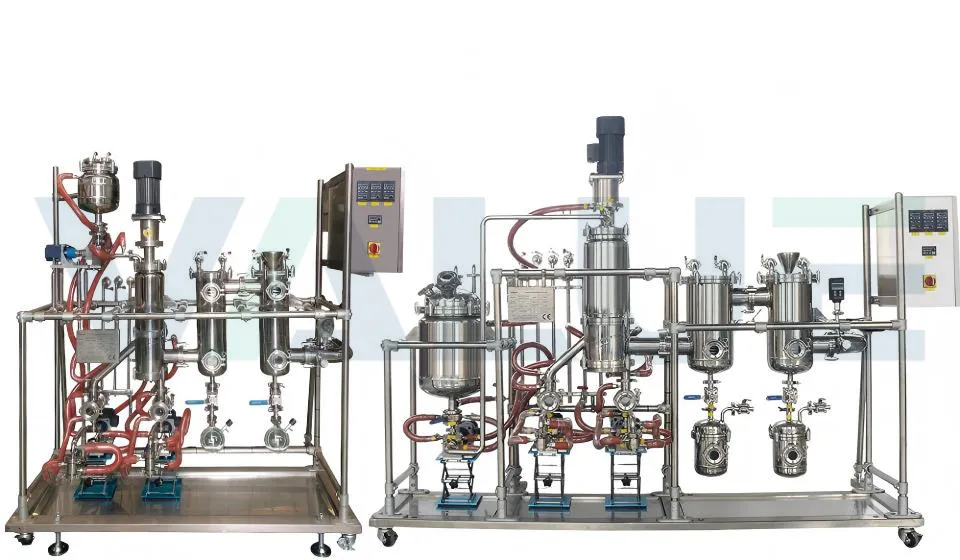
A typical wiped film molecular distillation system consists of several key components:
l Feed inlet
l Evaporator chamber
l Heating jacket
l Rotating wiper or rotor
l Internal condenser
l Residue outlet
l Distillate collection vessel
l High-vacuum connection
l Vacuum pump system
l Temperature and pressure control system
The exact configuration depends on the feed material, required throughput, separation target, and operating conditions.
How Does Wiped Film Molecular Distillation Work?
The operating principle can be understood through several basic stages.
1. The Feed Enters the Evaporator
The material to be processed is introduced into the upper section of the evaporator.
A controlled feed rate is important because the amount of material entering the system affects film thickness, evaporation performance, residence time, and overall separation efficiency.
2. The Rotor Spreads the Material Into a Thin Film
Once the feed reaches the heated surface, the rotating wiper distributes it across the inner wall.
The purpose of the rotor is not simply to mix the material. It continuously renews and spreads the liquid film, helping maintain effective contact between the feed and the heated surface.
A thinner film generally allows heat to transfer more efficiently and helps volatile components evaporate more readily.
3. The Heating Jacket Supplies Thermal Energy
A heating medium circulates through the jacket surrounding the evaporation chamber.
Heat passes through the chamber wall and into the thin liquid film.
Because the material is distributed into a thin layer, the system can achieve efficient heat transfer without requiring the entire bulk of the feed to remain at a high temperature for an extended period.
4. Vacuum Lowers the Effective Boiling Temperature
High vacuum is one of the defining features of molecular distillation.
Reducing the pressure lowers the boiling temperature of many substances. This makes it possible to evaporate certain components at temperatures significantly below their atmospheric boiling points.
For heat-sensitive materials, this can reduce the risk of thermal degradation.
5. Vapor Moves Toward the Condensing Surface
As the more volatile components evaporate, the vapor travels toward the condenser.
In a molecular distillation configuration, the evaporation and condensation surfaces are positioned relatively close to one another. This short vapor path helps reduce unnecessary vapor loss and supports separation under high-vacuum conditions.
6. Distillate and Residue Are Collected Separately
After condensation, the distilled fraction is collected in a dedicated receiver.
Components with lower volatility remain behind and are discharged as the residue or heavier fraction.
By controlling temperature, pressure, feed rate, and rotor speed, operators can adjust the separation conditions according to the characteristics of the material being processed.
Why Is a Thin Film Important in Molecular Distillation?
The formation of a thin liquid film is one of the main reasons wiped film systems perform differently from conventional evaporation equipment.
A thick layer of liquid creates a longer path for heat to travel from the heated surface to the material. It can also increase the time that the product spends under thermal stress.
The wiping mechanism continuously renews the liquid layer and helps prevent excessive accumulation of material on the heated wall.
This can provide several process advantages:
l More effective heat transfer
l Shorter product residence time
l More uniform exposure to the heated surface
l Reduced risk of localized overheating
l Better handling of viscous or heat-sensitive materials
The actual performance still depends on the properties of the feed and the operating parameters selected for the process.
Why Is Vacuum Important in Wiped Film Distillation?
Vacuum is not simply an optional accessory in molecular distillation. It is fundamental to how the separation process works.
At lower pressure, volatile compounds can evaporate at lower temperatures. This is especially useful when processing substances that are prone to oxidation, decomposition, discoloration, or other forms of thermal damage.
A stable vacuum environment also contributes to consistent separation performance.
For this reason, the vacuum system normally includes more than just a pump. Depending on the application, the complete setup may include:
l Vacuum gauge
l Vacuum valves
l Condenser
l Vacuum piping
l Cold trap or solvent recovery components
The selected vacuum equipment should be compatible with the required pressure range and the vapor load generated during operation.
What Are the Main Advantages of Wiped Film Molecular Distillation?
Reduced Thermal Exposure
One of the biggest advantages is the combination of high vacuum and short residence time.
Heat-sensitive materials can therefore be processed under conditions that may be gentler than conventional atmospheric distillation.
Efficient Heat Transfer
The rotating wiper continuously spreads the material over the heated surface.
This creates a large effective surface area relative to the amount of liquid being processed, supporting efficient evaporation.
Short Residence Time
The feed passes through the evaporation zone relatively quickly.
Shorter residence time can be particularly valuable for compounds that become unstable when exposed to heat for long periods.
Suitable for High-Boiling Materials
Some materials have boiling points that are too high for practical atmospheric distillation.
Molecular distillation can make the separation more feasible by reducing the operating pressure and consequently lowering the temperature required for evaporation.
Controlled Fraction Separation
By adjusting operating parameters, manufacturers can target different volatile fractions while retaining heavier components in the residue stream.
This makes the technology useful for purification and concentration processes where conventional evaporation may not provide sufficient selectivity.
What Materials Can Be Processed by Wiped Film Molecular Distillation?
The technology is generally considered for materials where conventional distillation creates challenges related to temperature, volatility, viscosity, or product stability.
Typical applications include:
Essential Oils and Natural Extracts
Wiped film systems can be used to separate or purify valuable volatile components from natural oils and extracts.
The relatively low-temperature operating conditions can help protect compounds whose aroma or functional properties may be affected by excessive heat.
Pharmaceutical Ingredients
Certain pharmaceutical intermediates and active ingredients require careful control of temperature during purification.
High-vacuum wiped film processing can provide an alternative for compounds that are difficult to handle using conventional distillation.
Specialty Chemicals
The equipment can be used for purification, concentration, and fractionation of specialty chemical products.
The stainless steel construction also makes the system suitable for demanding industrial environments when the material grade is properly selected.
Oils and Fatty Materials
Wiped film and molecular distillation technologies are commonly considered for processing various oils, fatty substances, and other high-boiling mixtures.
The objective may be to remove unwanted components, concentrate valuable fractions, or separate compounds according to volatility.
Heat-Sensitive Natural Compounds
Materials that may degrade under prolonged heating can benefit from a process that combines reduced pressure with short thermal exposure.
What Is the Difference Between Wiped Film Distillation and Conventional Distillation?
Traditional distillation usually depends on repeated vaporization and condensation inside a column or vessel.
Wiped film systems operate differently.
Instead of relying primarily on a long distillation column, the feed is distributed as a thin film across a heated surface. A mechanical rotor continuously renews the film, while a vacuum system reduces the boiling temperature.
This makes wiped film equipment particularly attractive for:
l High-boiling materials
l Heat-sensitive compounds
l Viscous feedstocks
l Products requiring short residence time
l Materials that are difficult to process under atmospheric pressure
However, conventional distillation may still be more appropriate for applications involving large quantities of relatively stable and easily separable components.
The best technology depends on the feed properties and the required separation performance.
Wiped Film Distillation vs. Falling Film Evaporation
Wiped film and falling film systems both create relatively thin liquid films, but their operating principles are different.
In a falling film evaporator, gravity causes the liquid to flow downward along the heated surface.
In a wiped film system, a mechanical rotor actively spreads the material and maintains the film.
The wiping action provides an important advantage when processing feeds that are viscous, difficult to distribute, or prone to fouling.
Another important difference is residence time. Wiped film equipment is often selected when minimizing thermal exposure is a priority.
Therefore, the choice between the two technologies should be based on factors such as viscosity, heat sensitivity, fouling tendency, evaporation load, and required throughput.
Why Is Stainless Steel Used for Wiped Film Systems?
Stainless steel is commonly selected for industrial wiped film equipment because of its combination of strength, corrosion resistance, cleanability, and durability.
Corrosion Resistance
Extraction, purification, and distillation processes may involve solvents or chemically active materials.
A suitable stainless steel grade can provide good resistance under many operating conditions.
Mechanical Durability
The rotor is continuously moving during operation, so the evaporator requires a robust mechanical structure.
Stainless steel provides the strength needed for repeated industrial operation.
Cleanability
Smooth stainless steel surfaces are generally easier to clean and maintain than many alternative materials.
This can be particularly important when equipment is used for products where cross-contamination needs to be controlled.
Long-Term Operation
With appropriate material selection and maintenance, stainless steel equipment can provide a long service life in demanding processing environments.
The specific steel grade, surface finish, seals, and internal components should still be selected according to the application.
What Factors Affect Wiped Film Distillation Performance?
A wiped film system does not operate effectively simply because the equipment has a high temperature or high vacuum.
Several parameters need to work together.
Feed Temperature
The feed temperature affects viscosity and evaporation behavior.
Heating Temperature
The heating medium determines how much thermal energy is available for evaporation.
Vacuum Level
Pressure influences the temperature at which components evaporate.
Feed Rate
If the feed rate is too high, the system may not provide sufficient heat-transfer capacity or residence time for the intended separation.
Rotor Speed
Wiper speed influences film formation, surface renewal, and residence time.
Feed Properties
Viscosity, volatility, thermal stability, composition, and solids content all influence the appropriate operating conditions.
For this reason, process optimization should be based on actual feed characteristics rather than relying on a single standard parameter set.
How Do You Choose a Wiped Film Molecular Distillation System?
Before selecting equipment, several questions should be answered.
What is the feed material?
Determine its viscosity, volatility, thermal stability, chemical compatibility, and composition.
What separation is required?
Clarify whether the objective is purification, concentration, fractionation, solvent removal, or recovery of a particular component.
What is the required processing capacity?
Throughput determines the appropriate evaporator size and supporting equipment.
What temperature range is required?
The heating system should provide sufficient thermal capacity while remaining within the safe operating range of the material.
What vacuum level is needed?
The vacuum pump and related components should be selected according to the target pressure and vapor load.
Is continuous operation required?
For production environments, continuous feed and discharge may provide advantages over batch processing.
What materials of construction are appropriate?
The vessel, rotor, seals, valves, and piping should all be compatible with the process material.
What Supporting Equipment Is Needed?
A wiped film molecular distillation system normally works as part of an integrated process.
Heating Circulator
A circulating heater supplies thermal fluid to the evaporator jacket and helps maintain the required evaporation temperature.
Vacuum Pump
The vacuum pump creates and maintains the reduced-pressure environment required for molecular distillation.
Different pump technologies may be appropriate depending on the target vacuum level and chemical vapor load.
Condenser
A condenser helps recover vapor and protect the vacuum system from excessive solvent or process vapor.
Feed Pump
A controlled feed pump can provide a stable material flow into the evaporator.
The correct pump type depends on viscosity and other feed characteristics.
Collection Vessels
Separate collection vessels are generally used for the distilled fraction and the remaining residue.
This allows the separated streams to be collected and transferred to subsequent processing stages.
Where Is Wiped Film Molecular Distillation Used?
Because of its ability to operate under high vacuum and minimize thermal exposure, wiped film molecular distillation can be applied in several areas.
Common examples include:
l Pharmaceutical processing
l Essential oil purification
l Natural product processing
l Specialty chemical purification
l Oil and fatty material processing
l High-boiling compound separation
l Heat-sensitive material concentration
The actual suitability of the technology should be confirmed through laboratory or pilot testing before full-scale production.
How Can Wiped Film Distillation Help Improve Product Quality?
The main contribution of wiped film molecular distillation is not simply faster evaporation. Its value comes from providing greater control over the separation environment.
High vacuum can reduce the required boiling temperature, while the thin film and wiping action help limit thermal exposure.
Together, these features can help manufacturers:
l Reduce unwanted thermal degradation
l Improve separation of volatile and less-volatile fractions
l Produce more consistent processing conditions
l Handle heat-sensitive materials more effectively
l Reduce the time products remain on heated surfaces
However, product quality ultimately depends on the entire process—including feed quality, equipment configuration, temperature, pressure, feed rate, rotor speed, and downstream handling.
Conclusion
Wiped film molecular distillation is a specialized high-vacuum separation technology designed for materials that may be difficult to process through conventional distillation.
Its operating principle combines thin-film formation, mechanical wiping, controlled heating, and reduced pressure. These features allow certain high-boiling or heat-sensitive materials to be processed with relatively short thermal exposure.
Stainless steel construction adds mechanical durability and corrosion resistance, making the technology suitable for a wide range of industrial applications.
When selecting a wiped film molecular distillation system, it is important to evaluate the feed properties, required throughput, vacuum level, temperature range, separation objective, and supporting equipment as one complete process rather than choosing the evaporator alone.
What Is Wiped Film Molecular Distillation and How Does It Work?
Wiped film molecular distillation is a specialized separation technology designed for processing materials that are difficult to purify using conventional distillation methods. It is particularly useful when the feed contains heat-sensitive, high-boiling, or valuable components that may degrade under prolonged exposure to elevated temperatures.
The process combines a thin-film evaporation surface, mechanical wiping, and high-vacuum operation. By spreading the feed into a very thin liquid film and reducing the operating pressure, the system promotes rapid evaporation while limiting the time that the material remains exposed to heat.
Stainless steel wiped film molecular distillation systems are widely used in chemical processing, pharmaceutical applications, essential oil purification, specialty materials, and other processes where controlled separation and product quality are important.
What Is Wiped Film Molecular Distillation?
Wiped film molecular distillation is a form of short-path or high-vacuum distillation in which a mechanical rotor continuously distributes the feed material across a heated evaporation surface.
Instead of allowing the liquid to form a thick layer inside a conventional evaporator, the wiping system creates a thin and relatively uniform film. This increases the effective heat-transfer area and shortens the distance that vapor molecules need to travel during separation.
The process is especially suitable for substances with relatively high boiling points or limited thermal stability.
A typical wiped film molecular distillation system consists of several key components:
l Feed inlet
l Evaporator chamber
l Heating jacket
l Rotating wiper or rotor
l Internal condenser
l Residue outlet
l Distillate collection vessel
l High-vacuum connection
l Vacuum pump system
l Temperature and pressure control system
The exact configuration depends on the feed material, required throughput, separation target, and operating conditions.
How Does Wiped Film Molecular Distillation Work?
The operating principle can be understood through several basic stages.
1. The Feed Enters the Evaporator
The material to be processed is introduced into the upper section of the evaporator.
A controlled feed rate is important because the amount of material entering the system affects film thickness, evaporation performance, residence time, and overall separation efficiency.
2. The Rotor Spreads the Material Into a Thin Film
Once the feed reaches the heated surface, the rotating wiper distributes it across the inner wall.
The purpose of the rotor is not simply to mix the material. It continuously renews and spreads the liquid film, helping maintain effective contact between the feed and the heated surface.
A thinner film generally allows heat to transfer more efficiently and helps volatile components evaporate more readily.
3. The Heating Jacket Supplies Thermal Energy
A heating medium circulates through the jacket surrounding the evaporation chamber.
Heat passes through the chamber wall and into the thin liquid film.
Because the material is distributed into a thin layer, the system can achieve efficient heat transfer without requiring the entire bulk of the feed to remain at a high temperature for an extended period.
4. Vacuum Lowers the Effective Boiling Temperature
High vacuum is one of the defining features of molecular distillation.
Reducing the pressure lowers the boiling temperature of many substances. This makes it possible to evaporate certain components at temperatures significantly below their atmospheric boiling points.
For heat-sensitive materials, this can reduce the risk of thermal degradation.
5. Vapor Moves Toward the Condensing Surface
As the more volatile components evaporate, the vapor travels toward the condenser.
In a molecular distillation configuration, the evaporation and condensation surfaces are positioned relatively close to one another. This short vapor path helps reduce unnecessary vapor loss and supports separation under high-vacuum conditions.
6. Distillate and Residue Are Collected Separately
After condensation, the distilled fraction is collected in a dedicated receiver.
Components with lower volatility remain behind and are discharged as the residue or heavier fraction.
By controlling temperature, pressure, feed rate, and rotor speed, operators can adjust the separation conditions according to the characteristics of the material being processed.
Why Is a Thin Film Important in Molecular Distillation?
The formation of a thin liquid film is one of the main reasons wiped film systems perform differently from conventional evaporation equipment.
A thick layer of liquid creates a longer path for heat to travel from the heated surface to the material. It can also increase the time that the product spends under thermal stress.
The wiping mechanism continuously renews the liquid layer and helps prevent excessive accumulation of material on the heated wall.
This can provide several process advantages:
l More effective heat transfer
l Shorter product residence time
l More uniform exposure to the heated surface
l Reduced risk of localized overheating
l Better handling of viscous or heat-sensitive materials
The actual performance still depends on the properties of the feed and the operating parameters selected for the process.
Why Is Vacuum Important in Wiped Film Distillation?
Vacuum is not simply an optional accessory in molecular distillation. It is fundamental to how the separation process works.
At lower pressure, volatile compounds can evaporate at lower temperatures. This is especially useful when processing substances that are prone to oxidation, decomposition, discoloration, or other forms of thermal damage.
A stable vacuum environment also contributes to consistent separation performance.
For this reason, the vacuum system normally includes more than just a pump. Depending on the application, the complete setup may include:
l Vacuum gauge
l Vacuum valves
l Condenser
l Vacuum piping
l Cold trap or solvent recovery components
The selected vacuum equipment should be compatible with the required pressure range and the vapor load generated during operation.
What Are the Main Advantages of Wiped Film Molecular Distillation?
Reduced Thermal Exposure
One of the biggest advantages is the combination of high vacuum and short residence time.
Heat-sensitive materials can therefore be processed under conditions that may be gentler than conventional atmospheric distillation.
Efficient Heat Transfer
The rotating wiper continuously spreads the material over the heated surface.
This creates a large effective surface area relative to the amount of liquid being processed, supporting efficient evaporation.
Short Residence Time
The feed passes through the evaporation zone relatively quickly.
Shorter residence time can be particularly valuable for compounds that become unstable when exposed to heat for long periods.
Suitable for High-Boiling Materials
Some materials have boiling points that are too high for practical atmospheric distillation.
Molecular distillation can make the separation more feasible by reducing the operating pressure and consequently lowering the temperature required for evaporation.
Controlled Fraction Separation
By adjusting operating parameters, manufacturers can target different volatile fractions while retaining heavier components in the residue stream.
This makes the technology useful for purification and concentration processes where conventional evaporation may not provide sufficient selectivity.
What Materials Can Be Processed by Wiped Film Molecular Distillation?
The technology is generally considered for materials where conventional distillation creates challenges related to temperature, volatility, viscosity, or product stability.
Typical applications include:
Essential Oils and Natural Extracts
Wiped film systems can be used to separate or purify valuable volatile components from natural oils and extracts.
The relatively low-temperature operating conditions can help protect compounds whose aroma or functional properties may be affected by excessive heat.
Pharmaceutical Ingredients
Certain pharmaceutical intermediates and active ingredients require careful control of temperature during purification.
High-vacuum wiped film processing can provide an alternative for compounds that are difficult to handle using conventional distillation.
Specialty Chemicals
The equipment can be used for purification, concentration, and fractionation of specialty chemical products.
The stainless steel construction also makes the system suitable for demanding industrial environments when the material grade is properly selected.
Oils and Fatty Materials
Wiped film and molecular distillation technologies are commonly considered for processing various oils, fatty substances, and other high-boiling mixtures.
The objective may be to remove unwanted components, concentrate valuable fractions, or separate compounds according to volatility.
Heat-Sensitive Natural Compounds
Materials that may degrade under prolonged heating can benefit from a process that combines reduced pressure with short thermal exposure.
What Is the Difference Between Wiped Film Distillation and Conventional Distillation?
Traditional distillation usually depends on repeated vaporization and condensation inside a column or vessel.
Wiped film systems operate differently.
Instead of relying primarily on a long distillation column, the feed is distributed as a thin film across a heated surface. A mechanical rotor continuously renews the film, while a vacuum system reduces the boiling temperature.
This makes wiped film equipment particularly attractive for:
l High-boiling materials
l Heat-sensitive compounds
l Viscous feedstocks
l Products requiring short residence time
l Materials that are difficult to process under atmospheric pressure
However, conventional distillation may still be more appropriate for applications involving large quantities of relatively stable and easily separable components.
The best technology depends on the feed properties and the required separation performance.
Wiped Film Distillation vs. Falling Film Evaporation
Wiped film and falling film systems both create relatively thin liquid films, but their operating principles are different.
In a falling film evaporator, gravity causes the liquid to flow downward along the heated surface.
In a wiped film system, a mechanical rotor actively spreads the material and maintains the film.
The wiping action provides an important advantage when processing feeds that are viscous, difficult to distribute, or prone to fouling.
Another important difference is residence time. Wiped film equipment is often selected when minimizing thermal exposure is a priority.
Therefore, the choice between the two technologies should be based on factors such as viscosity, heat sensitivity, fouling tendency, evaporation load, and required throughput.
Why Is Stainless Steel Used for Wiped Film Systems?
Stainless steel is commonly selected for industrial wiped film equipment because of its combination of strength, corrosion resistance, cleanability, and durability.
Corrosion Resistance
Extraction, purification, and distillation processes may involve solvents or chemically active materials.
A suitable stainless steel grade can provide good resistance under many operating conditions.
Mechanical Durability
The rotor is continuously moving during operation, so the evaporator requires a robust mechanical structure.
Stainless steel provides the strength needed for repeated industrial operation.
Cleanability
Smooth stainless steel surfaces are generally easier to clean and maintain than many alternative materials.
This can be particularly important when equipment is used for products where cross-contamination needs to be controlled.
Long-Term Operation
With appropriate material selection and maintenance, stainless steel equipment can provide a long service life in demanding processing environments.
The specific steel grade, surface finish, seals, and internal components should still be selected according to the application.
What Factors Affect Wiped Film Distillation Performance?
A wiped film system does not operate effectively simply because the equipment has a high temperature or high vacuum.
Several parameters need to work together.
Feed Temperature
The feed temperature affects viscosity and evaporation behavior.
Heating Temperature
The heating medium determines how much thermal energy is available for evaporation.
Vacuum Level
Pressure influences the temperature at which components evaporate.
Feed Rate
If the feed rate is too high, the system may not provide sufficient heat-transfer capacity or residence time for the intended separation.
Rotor Speed
Wiper speed influences film formation, surface renewal, and residence time.
Feed Properties
Viscosity, volatility, thermal stability, composition, and solids content all influence the appropriate operating conditions.
For this reason, process optimization should be based on actual feed characteristics rather than relying on a single standard parameter set.
How Do You Choose a Wiped Film Molecular Distillation System?
Before selecting equipment, several questions should be answered.
What is the feed material?
Determine its viscosity, volatility, thermal stability, chemical compatibility, and composition.
What separation is required?
Clarify whether the objective is purification, concentration, fractionation, solvent removal, or recovery of a particular component.
What is the required processing capacity?
Throughput determines the appropriate evaporator size and supporting equipment.
What temperature range is required?
The heating system should provide sufficient thermal capacity while remaining within the safe operating range of the material.
What vacuum level is needed?
The vacuum pump and related components should be selected according to the target pressure and vapor load.
Is continuous operation required?
For production environments, continuous feed and discharge may provide advantages over batch processing.
What materials of construction are appropriate?
The vessel, rotor, seals, valves, and piping should all be compatible with the process material.
What Supporting Equipment Is Needed?
A wiped film molecular distillation system normally works as part of an integrated process.
Heating Circulator
A circulating heater supplies thermal fluid to the evaporator jacket and helps maintain the required evaporation temperature.
Vacuum Pump
The vacuum pump creates and maintains the reduced-pressure environment required for molecular distillation.
Different pump technologies may be appropriate depending on the target vacuum level and chemical vapor load.
Condenser
A condenser helps recover vapor and protect the vacuum system from excessive solvent or process vapor.
Feed Pump
A controlled feed pump can provide a stable material flow into the evaporator.
The correct pump type depends on viscosity and other feed characteristics.
Collection Vessels
Separate collection vessels are generally used for the distilled fraction and the remaining residue.
This allows the separated streams to be collected and transferred to subsequent processing stages.
Where Is Wiped Film Molecular Distillation Used?
Because of its ability to operate under high vacuum and minimize thermal exposure, wiped film molecular distillation can be applied in several areas.
Common examples include:
l Pharmaceutical processing
l Essential oil purification
l Natural product processing
l Specialty chemical purification
l Oil and fatty material processing
l High-boiling compound separation
l Heat-sensitive material concentration
The actual suitability of the technology should be confirmed through laboratory or pilot testing before full-scale production.
How Can Wiped Film Distillation Help Improve Product Quality?
The main contribution of wiped film molecular distillation is not simply faster evaporation. Its value comes from providing greater control over the separation environment.
High vacuum can reduce the required boiling temperature, while the thin film and wiping action help limit thermal exposure.
Together, these features can help manufacturers:
l Reduce unwanted thermal degradation
l Improve separation of volatile and less-volatile fractions
l Produce more consistent processing conditions
l Handle heat-sensitive materials more effectively
l Reduce the time products remain on heated surfaces
However, product quality ultimately depends on the entire process—including feed quality, equipment configuration, temperature, pressure, feed rate, rotor speed, and downstream handling.
Conclusion
Wiped film molecular distillation is a specialized high-vacuum separation technology designed for materials that may be difficult to process through conventional distillation.
Its operating principle combines thin-film formation, mechanical wiping, controlled heating, and reduced pressure. These features allow certain high-boiling or heat-sensitive materials to be processed with relatively short thermal exposure.
Stainless steel construction adds mechanical durability and corrosion resistance, making the technology suitable for a wide range of industrial applications.
When selecting a wiped film molecular distillation system, it is important to evaluate the feed properties, required throughput, vacuum level, temperature range, separation objective, and supporting equipment as one complete process rather than choosing the evaporator alone.


